

Injectable Knee Cartilage Therapy Using Your Cells
Injectable MACT (Matrix-Associated Autologous Chondrocyte Transplantation) works to treat knee cartilage damage with your own cells, embedded in a hydrogel. Based on over 20 years of implant experience and new biomaterials, Injectable MACT is designed as an alternative approach to cartilage treatment.

Understanding the Basics
What Is Injectable MACT?
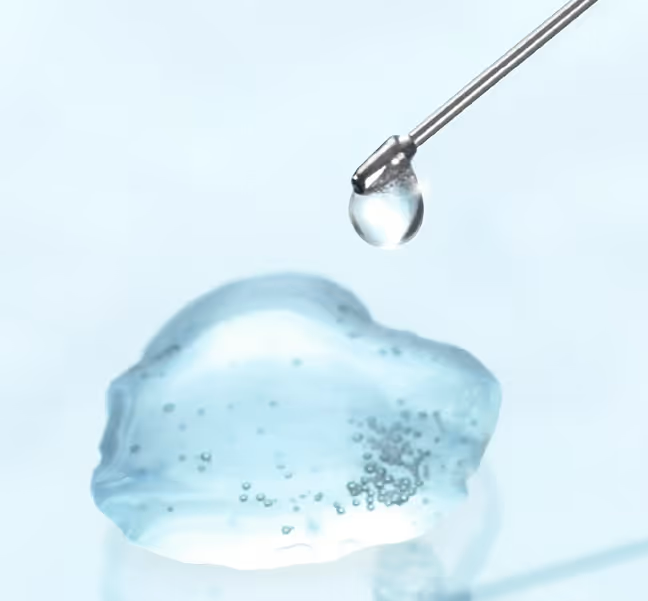
Injectable MACT is an injectable approach to Autologous Chondrocyte Implantation (ACI). With this procedure, your own cartilage cells are grown in a lab and mixed with a liquid gel when they are injected into the defect. The combined cells and hydrogel set in 1–3 minutes [1].
Available as Same-Day Surgery
Patients may walk out on crutches the same day, provided no extra work is done on ligaments or bone [2].
Over 10,000 Procedures in Germany
Since its introduction in 2008, more than 10,000 Injectable MACT procedures have been recorded in Germany [3].
Research in partial knee replacement shows that patients discharged the same day do just as well as those who remain overnight, with no higher chance of complications [4]. In Germany, Injectable MACT is also approved as a day-surgery procedure, meaning it can be carried out without an overnight hospital stay when appropriate.
- Patient History
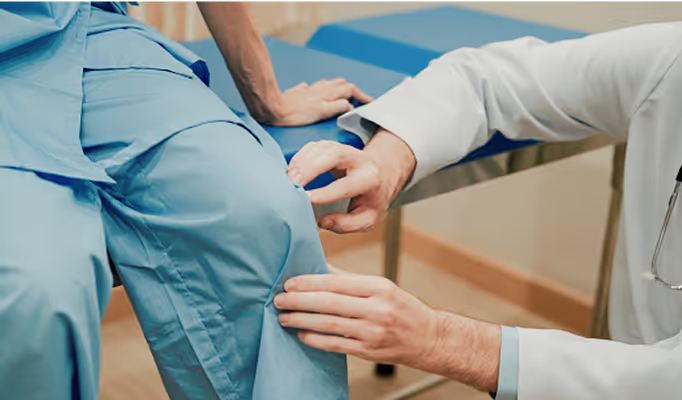
Doctor asks about how the injury happened, symptoms (pain, swelling, locking), physical activity, and prior knee issues. - Physical Examination
Manual tests to assess pain location, joint stability, swelling, range of motion, and signs of mechanical symptoms (e.g. catching, grinding). - Imaging
- X-ray: Rules out bone fractures or arthritis but can’t show cartilage directly.
- MRI: For visualising cartilage defects, soft tissues, and bone bruising.
- CT or CT-Arthrography: Used when MRI is unclear or unavailable.
- Arthroscopy (Optional)
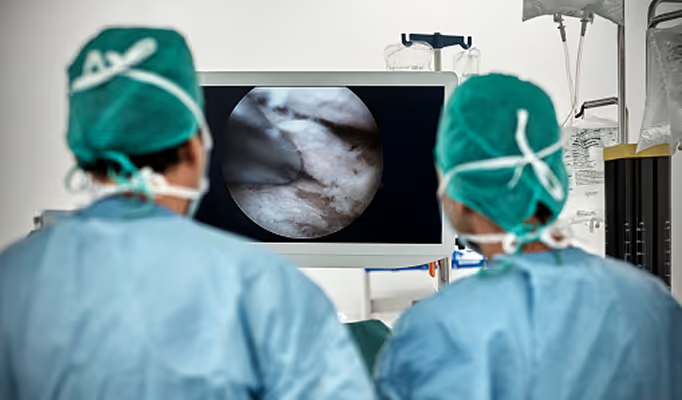
Minimally invasive camera-based procedure. Directly inspects cartilage and may be used if imaging is inconclusive or surgery is being planned. - Grading the Damage
Severity is classified by systems like ICRS Grade I–IV, based on how deep and wide the defect is.
Consult your physician or view our treatment centres.
When your surgeon decides it's safe, going home the same day can reduce time spent in hospital—time when certain risks are more likely.
Blood clots are linked to long periods of lying still. Early walking after knee surgery is associated with fewer clots and lung infections, and a shorter hospital stay [5].
The longer you stay in hospital, the greater the chance of being exposed to healthcare-associated infections [6].
When same-day discharge is appropriate, outpatient care reduces exposure to two proven risks—blood clots from immobility and hospital-acquired infections.
In Germany, public insurance (GKV) covers Injectable MACT for cartilage defects that meet defined size and health criteria [2]. Private insurance might also cover this procedure, but you need to check your plan.
After three small cartilage-bone cylinders are taken from your knee, your own cells are expanded over approximately 21 days in a sealed, sterile system.
Everything happens in a closed, ultra-clean environment. Trained technicians handle each step.
The growing conditions are tuned to match your cartilage cells: right temperature, humidity, and CO₂. This helps your cells stay healthy and remember their cartilage function.
Each batch is made only for you—no mixing, no reuse. Before it’s approved, your cells are tested for purity, health, and cartilage-specific markers. If anything’s off, the batch is discarded. No antibiotics or gene edits are used during manufacturing.
How It Works
Once a full-thickness defect has been diagnosed by a specialist, Injectable MACT proceeds in four distinct stages.
Tissue Sample
Healthy cartilage is biopsied from a non-weight-bearing knee. The sample is then transported under controlled conditions to our manufacturing facility for cell growth. Patients are released the same day.
Cell Growth at TETEC
Cells multiply under aseptic conditions in an appropriate GMP-facility for approximately 21 days. This forms the basis of the patient’s unique graft.

Injection Day
Cells embedded in a hydrogel are injected; the gel solidifies in 1–3 minutes, securing the graft in place [1].
Recovery and Rehabilitation
Usual recovery includes 48 hours without knee mobilisation (crutches may be used). Rehab is based on defect location, with physiotherapy and MRI at approximately 24 months [7].

What Researchers Have Found So Far
The number of studies evaluating Injectable MACT remains modest, and ongoing research may refine these findings with more data. Here is what they show so far:
- About 9 in 10 patients reported meaningful improvement after 2 and 5 years following Injectable MACT [8]. Some continued to experience pain or required a further procedure.
- MRI imaging studies suggest the new tissues resemble healthy cartilage [9].
- Long-term outcomes beyond 10 years for Injectable MACT are still being studied. However, other ACI approaches — including matrix-associated ACI (M-ACI) — have published outcomes over 10 years, demonstrating the durability of ACI as a treatment class.

What Could Go Wrong
Injectable MACT is a surgical procedure and may involve risks and complications. Your physician can explain the possible benefits and risks based on your individual diagnosis, the planned procedure, and your health history.
What Could Go Wrong?
Injectable ACI is a surgical procedure and may involve risks and complications. Your physician can explain the possible benefits and risks based on your individual diagnosis, the planned procedure, and your health history.
Frequently Asked Questions
An orthopaedic or sports-medicine doctor, usually with an MRI scan.
In a 100-person study, 93% reported meaningful improvement after 2 years, with sustained results at 5 years [8]. Ask your doctor for details.
Improvements often begin within the first few months; most recovery occurs within the first year [8]. Your recovery timeline may vary and your care team will tailor your plan.
After around 3 months, you may start with low-impact sports such as cycling or Nordic walking. After around 6 months, a gradual return to sports is possible. High-impact sports are not recommended in the first year after treatment [8].
The treatment failure rate for Injectable MACT is about 1 in 100 patients [8]. If Injectable MACT does not work, you are not committed to further options. If needed, your surgeon can discuss revision surgery or other treatments.

Is This Procedure an Option?
Only a medical examination can confirm if TETEC solutions suit your knee. Our procedures are not recommended for advanced or widespread osteoarthritis.
1. Niemeyer P, Hanus M, Belickas J, László T, Gudas R, Fiodorovas M, et al. Treatment of large cartilage defects in the knee by hydrogel-based autologous chondrocyte implantation: two-year results of a prospective, multicenter, single-arm phase III trial. Cartilage. 2022;13(1):19476035221085146. doi:10.1177/19476035221085146.
2. Gemeinsamer Bundesausschuss. Beschluss über eine Änderung der Richtlinie Methoden vertragsärztliche Versorgung: Matrixassoziierte autologe Chondrozytenimplantation am Kniegelenk. Berlin (DE): G-BA; 17. Februar 2022.
3. Data on File. TETEC AG. Internal registry and reporting of Injectable MACT and MACT procedures performed in Germany. Reutlingen (DE): TETEC AG; 2025.
4. Zhu JW, Wang TF, Chen DS, Lei L. Safety evaluation of outpatient vs inpatient unicompartmental knee arthroplasty: a systematic review and meta-analysis. Arch Orthop Trauma Surg. 2024;144(8):3615–3624. doi:10.1007/s00402-024-05446-8.
5. Lei YT, Xie JW, Huang Q, Huang W, Pei FX. Benefits of early ambulation within 24 h after total knee arthroplasty: a multicenter retrospective cohort study in China. Mil Med Res. 2021;8(1):17. doi:10.1186/s40779-021-00310-x.
6. Stewart S, Robertson C, Pan J, Kennedy S, Haahr L, Manoukian S, et al. Impact of healthcare-associated infection on length of stay. J Hosp Infect. 2021;114:23–31. doi:10.1016/j.jhin.2021.02.026.
7. TETEC AG. Fachinformation NOVOCART Inject. Reutlingen (DE): TETEC AG; 2022. Stand der Information: 12/2022. PEI.A.11763.01.1.
8. Niemeyer P, Hanus M, Belickas J, László T, Gudas R, Fiodorovas M, et al. Treatment of large cartilage defects in the knee by hydrogel-based autologous chondrocyte implantation: a 5-year follow-up of a prospective, multicenter, single-arm phase III trial. Cartilage. 2025. Epub ahead of print. doi:10.1177/19476035251334737.
9. Janáčová V, Szomolanyi P, Kirner A, Trattnig S, Juras V. Adjacent cartilage tissue structure after successful transplantation: a quantitative MRI study using T2 mapping and texture analysis. Eur Radiol. 2022;32(12):8364–8375. doi:10.1007/s00330-022-08897-y.