
Knee Care With Your Cells
If you're living with persistent knee pain, damaged cartilage may be the cause. Left untreated, it can worsen over time [1]. TETEC treatments use your own cells in approaches designed to support cartilage repair, with the goal of improving joint function and reducing pain [2].

Why Treating Cartilage Damage Matters
Reducing Pain and Improving Joint Function
Cartilage is the smooth tissue that cushions your knee, allowing bones to glide smoothly instead of rubbing together. A sudden injury or years of heavy use can damage this protective tissue and can cause chronic joint complaints such as pain, swelling, effusions, stiffness, and joint locking.
Because cartilage has no blood supply, the body struggles to heal this type of damage. Pain medication and physical exercises may offer temporary relief, but in some cases surgery may be indicated to reduce pain and improve joint function [3].
Preventing Further Knee Deterioration
If left untreated, cartilage defects may enlarge over time, increasing the likelihood of future joint degeneration and osteoarthritis, which ultimately may require knee replacement. Evidence suggests that cartilage repair surgery can help prevent progression of knee degeneration [4].

"Not all cartilage is created equal. TETEC solutions can help regenerate healthy, durable cartilage using the patient's own cells."
Current Surgical Options
A working-group of doctors from the German Society for Orthopaedics and Trauma Surgery (DGOU) has recommended several surgical options for full-thickness defects [3].
Which Could Be Right for You?
TETEC develops two personalised treatments for knee cartilage treatment, both using the patient's own cells: Injectable MACT (Matrix-Associated Autologous Chondrocyte Transplantation) and MACT.
Injectable MACT Procedure
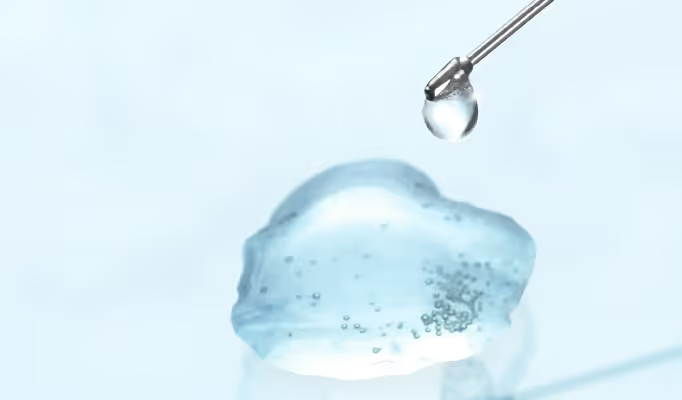
Injectable MACT is a cell-based cartilage-repair procedure in which a patient's own cartilage cells are combined with a hydrogel and implanted into a focal knee cartilage defect [5]. In clinical studies and earlier publications, this approach is also described as hydrogel-based ACI or injectable MACI.
- Injectable hydrogel containing the patient's cartilage cells
- Implanted arthroscopically through small incisions
- Available as outpatient or inpatient care, as appropriate
MACT Procedure
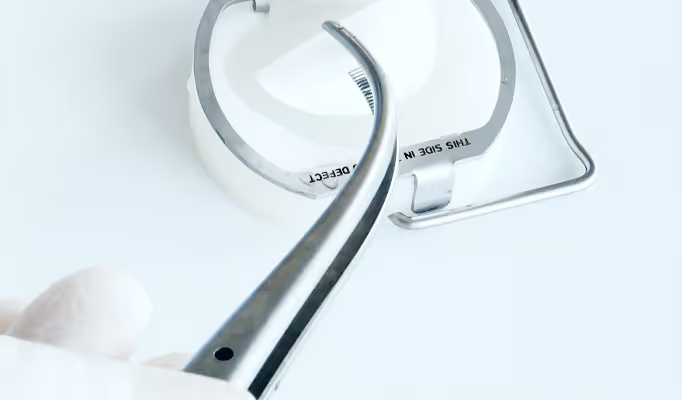
In MACT, the patient's own cells are placed on a collagen scaffold and implanted for the treatment of focal knee cartilage defects [6].
- Patch-like scaffold seeded with the patient's cartilage cells
- Implanted through a standard surgical incision
- Available as outpatient or inpatient care, as appropriate

Treatment Centres for Cartilage Repair
Only a medical examination can determine whether a cell-based cartilage-repair procedure may be appropriate for your individual case. These procedures are not generally intended for advanced or widespread osteoarthritis.
1. Pettit RJ, Everhart JS, DiBartola AC, Blackwell RE, Flanigan DC. Time matters: knee cartilage defect expansion and high-grade lesion formation while awaiting autologous chondrocyte implantation. Cartilage. 2021;13(2 Suppl):1802S–1808S. doi:10.1177/19476035211063866.
2. Niemeyer P, Hanus M, Belickas J, Laute V, Zinser W, Angele P, et al. Treatment of large cartilage defects in the knee by hydrogel-based autologous chondrocyte implantation: two-year results of a prospective, multicenter, single-arm phase III trial. Cartilage. 2022;13(1 Suppl):19476035221085146. doi:10.1177/19476035221085146.
3. Niemeyer P, Albrecht D, Aurich M, Becher C, Behrens P, Bichmann P, et al. Empfehlungen der AG Klinische Geweberegeneration zur Behandlung von Knorpelschäden am Kniegelenk. Z Orthop Unfall. 2023;161(1):57–64. doi:10.1055/a-1663-6807.
4. Jungmann PM, Gersing AS, Baumann F, et al. Cartilage repair surgery prevents progression of knee degeneration. Knee Surg Sports Traumatol Arthrosc. [? 2019 ?];27(9):3001–3013. doi:10.1007/s00167-018-5321-8.
5. TETEC AG. Fachinformation NOVOCART® Inject. Reutlingen (DE): TETEC AG; 2026. Stand der Information: 05/2026. PEI.A.11763.01.1.
6. TETEC AG. Fachinformation NOVOCART® 3D. Reutlingen (DE): TETEC AG; 2023. Stand der Information: 11/2023. PEI.A.11511.01.1.